What Does External NIS2 Consulting Really Cost? Costs, Models and Alternatives
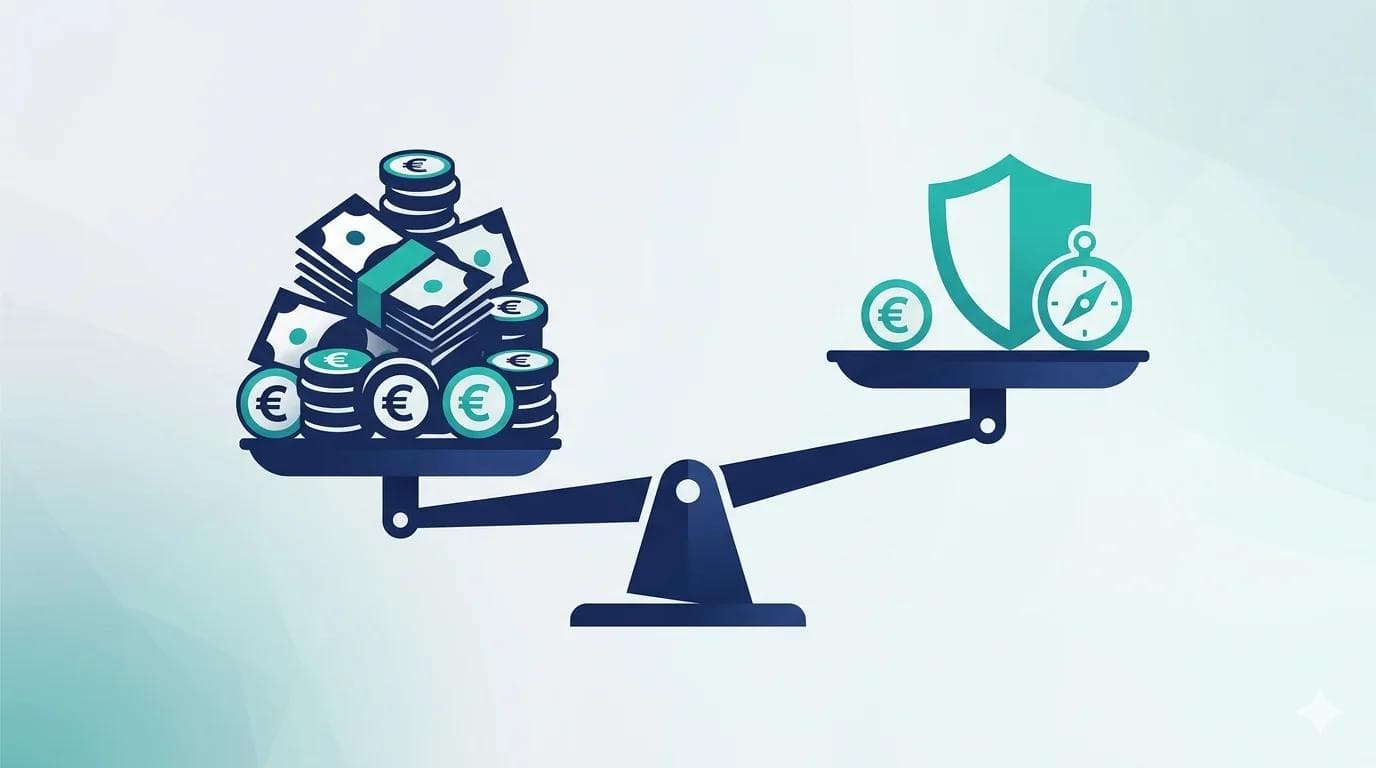
What does external NIS2 consulting cost? A consulting day averages 1,300 EUR (BDU), the full implementation about 70,000 EUR per company. NIS2Compass costs a fraction from 29 EUR/month.
What does external NIS2 consulting really cost? According to the Bundesverband Deutscher Unternehmensberatungen (BDU), a single consulting day costs 1,300 EUR on average, while the German government's draft bill puts the full NIS2 implementation at roughly 70,000 EUR per company on average. NIS2Compass offers a structured alternative for 29 EUR per month, making it only a fraction of the cost of classic consulting.
How much does external NIS2 consulting cost on average?
According to the BDU, a consulting day costs 1,300 EUR on average, and up to 1,600 EUR with partners. The German government's draft bill puts the full NIS2 implementation at roughly 70,000 EUR as a one-time cost per company on average. How many consulting days you need depends on your IT maturity and existing documentation.
The most reliable figure for consultant fees comes from the Bundesverband Deutscher Unternehmensberatungen. According to the BDU study "Honorare im Consulting 2025", the average billed daily rate is 1,300 EUR. An analyst costs around 700 EUR, while a managing director or partner runs about 1,600 EUR per day. IT consulting recorded the sharpest decline in the market at minus 3 percent.
How many of these days a NIS2 implementation consumes depends heavily on your starting point. If you already have ISO 27001 documentation and a well-maintained asset inventory, you need significantly fewer consulting days than a company starting from scratch.
The official overall estimate comes from the regulatory impact assessment for the NIS2UmsuCG (Bundestag-Drucksache 20/13184). The legislator estimates roughly 2.1 billion EUR in one-time and roughly 2.2 billion EUR in annual compliance cost for the economy, spread across about 30,000 affected companies. Broken down, that works out to an average of roughly 70,000 EUR one-time and 73,000 EUR annually per company.
Important: this average mixes small businesses with simple IT and corporations with international sites. External consulting is only one item among several. You will find a full breakdown in the article NIS2 compliance costs.
Which pricing models do NIS2 consultants offer?
NIS2 consultants typically bill according to four models: daily rate, fixed project fee, hourly fee, and hybrid or retainer models. Which model pays off depends on the project scope. A fixed fee suits clearly defined tasks, while a daily rate fits open-ended engagements better.
The following models are common in the German market:
- Daily rate: The industry standard. According to the BDU, the average daily rate is 1,300 EUR, and 1,600 EUR with partners. Watch out for hidden items: according to the BDU, 54 percent of consultancies bill travel time within the daily rate, and 57 percent map incidental costs there. The flat travel surcharge averages 190 EUR. Ask about this specifically before signing a contract.
- Fixed project fee: A fixed price for a clearly defined scope, often staggered as a phase package (gap analysis, implementation plan, implementation support). The advantage is planning certainty. The downside: every change in scope triggers a renegotiation.
- Hourly fee: Suitable for specific questions or individual expert opinions. The model is flexible, but carries the risk of gradual scope creep if the engagement is not clearly delimited.
- Hybrid / retainer: A monthly base fee secures on-call availability. This model often includes an incident response component that guarantees a fast reaction in an emergency.
A structured platform like NIS2Compass works on a different principle. Instead of variable daily rates, you pay a flat monthly fee that covers the entire implementation path. You will find an overview of the terms on the NIS2Compass pricing page.
What makes NIS2 consulting so expensive?
NIS2 consulting is expensive mainly because it combines scarce specialist expertise with high liability. Consultants must master IT, law and organization simultaneously. On top of that comes the extensive documentation burden that §30 BSIG prescribes for every security measure.
Four factors drive the cost:
Scarce specialist expertise: A NIS2 consultant has to bring together IT, compliance, law and organization. This combination is rare in the market and correspondingly expensive. Consultants factor in not only salary but also acquisition, insurance, overhead and profit. That explains an average daily rate of 1,300 EUR according to the BDU study "Honorare im Consulting 2025".
Liability risk: Consultants are liable if faulty documentation causes problems during a BSI audit. Professional indemnity insurance is therefore a fixed cost component. This risk is reflected in the daily rate.
Documentation burden: §30 BSIG requires not only implementation but the complete documentation of all security measures. Policies, risk analyses and evidence make up a large part of the project effort. This work is time-intensive and hard to accelerate.
Management coordination: §38 BSIG obliges management to approve and monitor the measures. Workshops, training and change management noticeably extend projects.
Many companies underestimate the coordination effort with management. That is often exactly where most of the additional consulting days arise.
These four factors add up quickly. If you prepare the documentation and coordination part internally in a structured way, you significantly reduce the expensive consulting days. This is exactly where NIS2Compass comes in, with ready-made templates and a clear implementation path.
How much does the full NIS2 implementation cost?
External consulting is only one part of the bill. The official regulatory impact assessment for the NIS2UmsuCG estimates the compliance cost for the economy at roughly 2.1 billion EUR one-time and roughly 2.2 billion EUR annually. Per company, that is an average of about 70,000 EUR one-time and 73,000 EUR annually.
If you look only at consultant fees, you significantly underestimate the budget. The regulatory impact assessment (Bundestag-Drucksache 20/13184) assumes around 30,000 affected companies. According to the legislator, the one-time effort is almost entirely attributable to the introduction or adaptation of digital process flows.
A NIS2 implementation spreads across several cost types, which are already included in this average:
- External consulting: Consultant fees by daily rate or fixed fee (BDU average 1,300 EUR/day)
- Internal staff: Proportional capacity of IT management and the information security officer (ISB)
- Technical measures: Logging, monitoring, multi-factor authentication and backup
- Training: Awareness training for employees and management
- Supply chain security: Assessment and contract adjustments for critical suppliers
The key is separating one-time and recurring costs. This is also reflected in the official estimate: the one-time effort of roughly 2.1 billion EUR is offset by an annually recurring effort of roughly 2.2 billion EUR. Consulting is usually a one-time expense, while staff, tools and training cost money again every year.
For budgeting, it is advisable to involve the CFO early. Consulting costs are tax-deductible as operating expenses and therefore reduce the effective burden. The article NIS2 consultant or do it yourself? A cost comparison shows which items can be reduced through your own work.
Where does external NIS2 consulting pay off — and where not?
External consulting pays off above all for KRITIS facilities, complex cloud environments and a lack of compliance experience. For documented SMEs with their own IT team, structured in-house work plus a targeted review is often significantly cheaper. The right choice depends on maturity level, architecture and time budget.
There is no blanket recommendation. What matters is where your company stands today.
Full external consulting makes sense for: KRITIS and especially important entities that are subject to stricter obligations under §28 BSIG. Likewise for pure cloud or hybrid architectures with special requirements, as well as for companies with no compliance background at all.
Hybrid (platform plus targeted review) makes sense for: SMEs with an IT manager and an existing asset inventory. If you have enough time buffer and act as a budget-conscious mid-sized company, this path usually serves you best.
The hybrid approach keeps expertise in-house and significantly reduces ongoing costs.
Worked example: What does a machine builder with 100 employees pay?
A machine builder with 100 employees, one IT manager and three technicians has just determined that it falls under NIS2. No dedicated budget exists yet. Three paths are available. The following figures are an example calculation based on the BDU average daily rate of 1,300 EUR.
Path A — full consulting: Assuming roughly 40 consulting days at 1,300 EUR, that comes to about 52,000 EUR, plus internal coordination. The IT team learns little in the process.
Path B — hybrid: NIS2Compass provides structure and templates for 29 EUR per month. The IT manager implements it themselves, while two to three external review days validate the result. That costs roughly 2,600 to 3,900 EUR and keeps expertise in-house.
Path C — in-house: NIS2Compass plus one final review day. This path takes the longest but offers maximum ownership.
For many mid-sized companies, the hybrid path is the optimum. §30 BSIG requires appropriate measures, not the most expensive route.
How do I implement NIS2 without expensive external consulting?
With a structured guide, ready-made templates and clear steps, SMEs implement the majority themselves. NIS2Compass combines an 8-chapter guide with 45+ templates for 29 EUR/month. This turns a confusing catalogue of obligations into a traceable implementation path.
In-house work does not work for everyone, but it does for most SMEs. A few prerequisites are decisive:
- A dedicated person with an IT background (part-time, no full-time profile needed)
- Backing from management, which is obligated anyway under §38 BSIG
- Structured guidance instead of tedious legal research of your own
- Ready-made templates instead of empty Word documents without orientation
This is exactly where NIS2Compass comes in and delivers the missing structure:
- NIS2 Guide: Step by step through all 8 chapters, with each substep providing a concrete Definition of Done and a directly linked template. More on this in the NIS2 Guide.
- Template Library: Over 20 ready-to-use Word and Excel templates, from the risk matrix to the IS policy to incident response. All templates are in the Template Library; for incident response, the reporting template under Section 32 BSIG fits.
- Pre-Check: A free gap analysis without login that reveals your biggest gaps in around 10 minutes. For a self-assessment, you can also use the NIS2 checklist as an Excel template.
The cost comparison is clear: 29 EUR per month instead of an implementation effort averaging roughly 70,000 EUR (the German government's draft bill). Put differently: an entire year of NIS2Compass costs 348 EUR and therefore less than a single consulting day (1,300 EUR on average according to the BDU). The platform is thus not just a little cheaper, but amounts to a fraction of a classic consulting project. A targeted external review on critical questions remains optional at any time.
An honest delimitation is part of this. For KRITIS facilities, companies with no IT staff at all, or highly complex special cases, classic consulting remains the right path. NIS2Compass is aimed at SMEs that want to implement in a structured way themselves. How this works in detail as an alternative to NIS2 consulting is shown on the use case page.
The article Digital NIS2 consultant vs. classic consulting examines where the line between platform and consulting sensibly runs.
Want to know where your company stands today? Start with the free Pre-Check and see your biggest NIS2 gaps in just a few minutes; all requirements to tick off are in the NIS2 checklist as an Excel template.
Frequently Asked Questions
Are more expensive NIS2 consultants automatically better?
No. The daily rate alone says little about quality. According to the BDU, there is more than a twofold difference between an analyst (average 700 EUR) and a partner (average 1,600 EUR). What matters is specialization, industry knowledge and references. For a classic NIS2 implementation, an experienced senior consultant is often sufficient. Check concrete project evidence rather than just the price.
Can I negotiate the price with the consultant?
Yes. A certain amount of room for negotiation is common, especially with longer contracts, follow-up engagements or flexible time windows. Fixed project fees can often be negotiated better than pure daily rates. Obtain several quotes and use them as a basis for comparison in your discussion.
What is included in a standard consulting package?
Typical components are an applicability assessment, gap analysis, policy documentation, catalogue of measures and management documentation. What is usually not included is the technical implementation, on-site training and ongoing incident response service. Before signing a contract, actively ask about scope and out-of-scope items to avoid later additional costs.
Does cyber insurance pay for the NIS2 implementation?
Rarely. Cyber insurance covers reactive damages after an incident, not preventive compliance implementation. The company itself bears the costs for consulting, policies and measures for the NIS2 implementation. A policy therefore does not replace a structured implementation of the NIS2 requirements.
Are NIS2 consulting costs tax-deductible?
Yes. NIS2 consulting is a business expense and deductible as an operating expense. Keep the invoice and consulting report as evidence and discuss the correct booking with your tax advisor. This way, part of the implementation costs can be recovered through tax relief.
Sources
- BDU — Bundesverband Deutscher Unternehmensberater: Study "Honorare im Consulting 2025"
- Deutscher Bundestag: Regulatory impact assessment for the NIS2UmsuCG, Drucksache 20/13184
- Gesetze im Internet: BSIG (§§ 28, 30, 38)
NIS2 templates for your implementation
Word and Excel templates with section references, each mapped to an implementation step under §30 BSIG.
View the NIS2 templatesRelated Articles
PHP2Shell: What NIS2 Entities Need to Do Now
PHP2Shell (CVSS 9.2) alone does not trigger a reporting obligation. A significant incident does. What § 30 BSIG requires now and what applies to manufacturers under the CRA.
5 min read
CRA for Machinery: Which Connected Products Count?
Which connected machine components fall under the Cyber Resilience Act? PLCs, HMIs, gateways, the Machinery Regulation and smart meter gateways at a glance.
10 min read
Vienna Data Leak: Does NIS2 Apply to German Municipalities?
Attackers copied 26,000 documents from the City of Vienna. In Germany, core municipal administration is outside NIS2 scope, but municipal enterprises can be covered.
5 min read