Blossom Health cyberattack: the extortion note landed in patients' inboxes
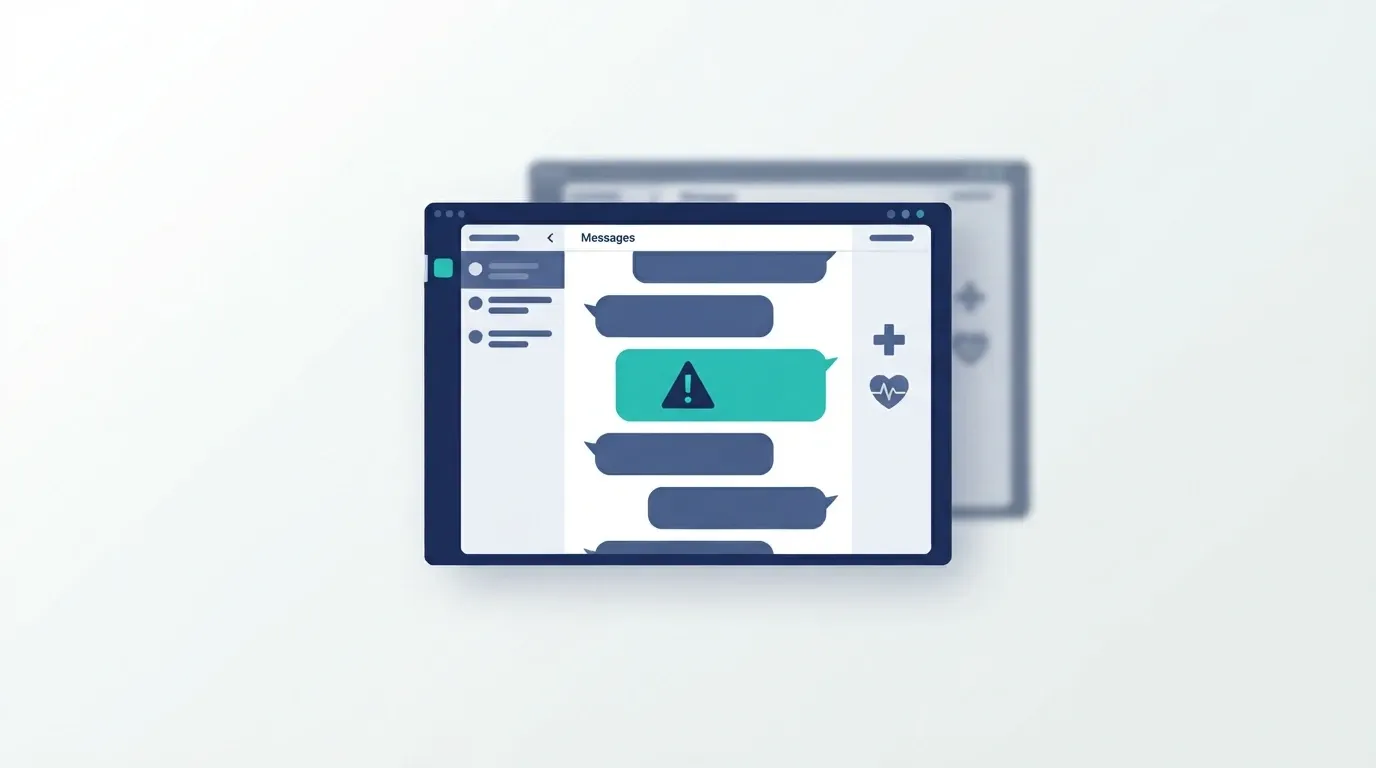
An extortionist sent his demand directly through Blossom Health's patient messaging. What is reported, what remains open, and which obligations would apply in Germany.
Patients of a US telepsychiatry platform found a ransom demand sitting directly in their patient portal inbox [1]. What is reported, what remains open, and which obligations would apply in Germany.
Written by the NIS2Compass editorial team · As of: September 1, 2026
The entire account of this incident rests on a single initial report by DataBreaches.net dated August 31, 2026 [1]. Blossom Health has not commented, and no authority has confirmed the case. This analysis therefore consistently distinguishes between reports supported by screenshots, unverified claims by the attacker, and checks carried out by DataBreaches. It will be updated as new information emerges.
Key takeaways
- Extortion in the patient inbox: On August 27, 2026, patients of the US telepsychiatry platform Blossom Health received — according to reports supported by patient screenshots — a three-part extortion message directly in their inbox in the authenticated patient messaging portal, sent under the profile of a clinician ("Justine Belesario", name and photo; in DataBreaches' assessment most likely not a genuine profile) [1].
- No confirmation: Blossom Health has remained silent so far: two unanswered press inquiries, no notice on its website (as of August 31). No authority has confirmed the case; the only source is the initial report by DataBreaches.net [1].
- Attack path unproven: The only account of the attack path is an unverified claim by the extortionist: access via an old staging environment, and from there into production. Allegedly, more than 29,600 records are affected [1].
- Regulatory contrast: In the US, the HIPAA rule allows up to 60 days for notifying affected individuals [6]. In Germany, the 24h/72h/1-month reporting cascade under § 32 BSIG [7] and the 72-hour deadline of the GDPR under Art. 33 [8] would apply.
- Transferable lesson: In this case, the affected individuals learned of the incident before any official communication [1]. Reporting channels and crisis communication must be in place before an emergency. This lesson does not depend on whether the claim about the attack path is true.
What happened
On Thursday, August 27, 2026, a three-part message appeared in Blossom Health's patient messaging portal, posted under the clinician profile "Justine Belesario", complete with name and photo [1]. This is supported by screenshots from affected patients that DataBreaches has on file [1].
The content according to these screenshots: the sender claims access to "more than 29.6K unique client records", including names, phone numbers, email addresses, home addresses, dates of birth, further sensitive data, and company documents [1]. He demands 30,000 US dollars in Bitcoin by September 4, threatening publication otherwise; the message also contains a negotiation offer and contact addresses [1]. All of this remains unverified attacker claims. This is pure data extortion: no encryption or operational disruption by ransomware has been reported [1].
About the company: Blossom Health is a telepsychiatry start-up from New York, founded in 2024. The AI-powered platform offers "AI copilots" for diagnosis, billing, and documentation [4]. In March 2026, the company announced a total of 20 million US dollars in funding from its seed and Series A rounds [4][5]. According to company statements via the press, it serves hundreds of clinicians and more than 10,000 patients across several US states [5].
The case did not become public through the company or an authority, but through an affected patient. That patient contacted DataBreaches.net with screenshots; the initial report was published on August 31, 2026 [1].
A response from Blossom Health is still outstanding. Two press inquiries from DataBreaches, on Thursday and on Saturday, went unanswered [1]. At the time of publication, the website carried no notice of the incident [1]. Whether authorities have been informed is unknown.
DataBreaches carried out its own checks. No licensed psychiatrist or neurologist named "Justine Belesario" could be found; in DataBreaches' assessment, the profile is most likely not genuine [1]. The Bitcoin address in the message is also invalid [1].
One numerical tension remains open: the extortionist claims more than 29,600 records, while the press reported more than 10,000 patients in March [5]. This article comes back to that.
How the attack is said to have unfolded
The sequence of events is not confirmed. According to unverified statements the extortionist made to DataBreaches, the attack ran through an old staging environment, from there into production, and ultimately to access to over 29,600 records [1]. Only the final stage is independently supported: the extortion message in the patient inbox, backed by screenshots [1].
This yields a chain of four stages:
- Access: The attacker claims to have broken in via an "old staging environment" — unverified [1]. This is the first time any access route has been named at all. In the attacks on the telehealth providers OpenLoop and Zealthy, which reporting attributes to the same perpetrator, this point always remained open [2].
- Lateral movement: From the staging environment into production. This too is purely an attacker claim, unverified [1].
- Data access: Allegedly more than 29,600 records. The scope is unverified, and no publicly examined samples exist [1].
- Extortion message in patient messaging: The message reached patients' inboxes. The screenshots show this [1]. That it was a "mistake" — a mass blast to more than 30,000 patients that he could not stop — is, again, only his claim [1].
Speaking to DataBreaches, the extortionist, who identified himself under the alias "Stuckin2019", said "too many things had gone wrong at once"; perhaps he had been "too tired" [1]. The editorial team recognized the sender from earlier email contact [1].
The status of the clinician profile "Justine Belesario", from which the message was sent, remains open. Whether it is a fake account, a compromised genuine account, or a platform artifact is unresolved. DataBreaches found no licensed clinician by that name [1].
Three questions therefore remain unanswered: When did the initial access occur, and how long did the attacker go unnoticed? Did the data access actually happen at the claimed scale? And did Blossom Health detect the incident itself — and when?
Where the attack could have been broken
Old staging environments are a security risk because they run outside regular operations: they often remain unpatched and unmonitored, and they frequently contain real credentials or even real data. Attackers find such forgotten systems through automated scanning and use them as an unwatched back door into production.
What protective measures Blossom Health had in place, no one outside the investigation knows. What can be described, however, is which measures generally work at the stages of this attack path. Important caveat: stages one through three rest on the attacker's unverified claim. The measures remain worthwhile even if the actual access route was a different one.
- Access stage (old staging environment): What works here is an inventory of all non-production environments and the consistent decommissioning of retired systems. This is the cheapest measure in the entire chain: shutting things down costs almost nothing. A forgotten environment, by contrast, remains permanently unwatched and unpatched. § 30 Abs. 2 Nr. 1 and Nr. 9 BSIG demand exactly this basic order [7].
- Lateral movement stage (staging to production): At this stage, strict separation works: separate networks, separate identities, separate secrets. No credential may be valid in both worlds. Multi-factor authentication belongs on all administrative access (Nr. 5, Nr. 9, Nr. 10 [7]).
- Data access stage: Real data has no place in staging; synthetic or anonymized test data serves testing just as well. Where real data seems unavoidable, that is a risk decision for management, not a developer default (Nr. 5, Nr. 1; supported by cryptography concepts under Nr. 8 [7]).
- Mass-message-in-portal stage: What works here is monitoring for unusual mass actions. An account that messages tens of thousands of recipients must trigger an alarm and be automatically throttled or stopped. That is detection and response capability in the sense of Nr. 2 and Nr. 6 [7].
- Across all stages: When every technical measure has failed, prepared crisis communication for the scenario "the affected individuals know first" is what works. That includes a communication plan, pre-drafted building blocks, and clearly assigned responsibilities (Nr. 3 [7]).
None of these measures is exotic: each one targets a stage of the reported attack path. Which reporting obligations apply when an incident happens anyway is the subject of the next section.
What the incident costs
For this incident, almost nothing has been quantified. No damage figure, no downtime, no confirmed number of affected individuals. The only price information is the demanded sum of 30,000 US dollars (reported [1]): an extortion amount, not a damage amount.
The harm to patients occurred the moment the extortion was delivered. Psychotherapy data ranks among the most sensitive data categories there are. Anxiety and loss of trust take effect regardless of whether the data exfiltration is real at the claimed scale: the delivery is supported by screenshots, the scope is merely claimed [1]. The extortionist himself told DataBreaches he expected a reaction "because it hosts psychotherapy data" [1].
On the company side, no outage has been reported so far, and no figure exists (as of current reporting [1]). The cost logic is nonetheless clear: forensics, incident response, and the HIPAA notification process. DataBreaches considers the case a presumably reportable breach even without payment, since even a botched attack can be reportable (assessment [1]).
Add to that possible civil consequences: in the comparable OpenLoop case, a class action has been running since February 2026 (reported [2]), and 716,000 affected individuals were ultimately reported there (reported [3]). On top of that comes the reputational risk for a start-up just months after a 20-million-US-dollar funding round (reported [4]).
The sector pays as well. This is already the third telehealth case since the start of the year attributed to the same perpetrator alias: OpenLoop, Zealthy, now Blossom Health (reported [2]). Regulatory and insurance pressure on telemedicine providers keeps rising as a result, even if it cannot be quantified today.
Whether a company remains capable of acting in this situation is decided by its crisis management under § 30 Abs. 2 Nr. 3 BSIG [7] — and by the reporting obligations covered in the next section.
Which obligations would have applied in Germany
When patient data is stolen, two reporting obligations apply in parallel in Germany. Under § 32 BSIG, affected entities report to the BSI in a cascade: early warning within 24 hours, report within 72 hours, final report within one month [7]. In addition, Art. 33 GDPR requires notification of the data protection authority within 72 hours, and Art. 34 requires notifying the affected individuals where there is a high risk [8].
The US situation: why there may be nothing to see yet
In the US, the HIPAA Breach Notification Rule governs such cases [6]. It requires notifying affected individuals without unreasonable delay, and no later than 60 days after discovery. From 500 affected individuals upward, a report to the US Department of Health and Human Services (HHS) is added, at the same time as the individual notifications; if more than 500 residents of a single state are affected, a media notice is required as well [6]. Even if Blossom Health has long been working through the incident internally, anything publicly visible would only become mandatory weeks later; the silence so far is compatible with US law.
The contrast: BSIG scope since December 2025
In the health sector, the BSIG covers, among others, providers of healthcare services (Annex 1) [7]. An important entity is anyone with at least 50 employees, or with both turnover and balance sheet total above 10 million euros each. Particularly important entities start at 250 employees, or above 50 million euros in turnover and above 43 million euros in balance sheet total (§ 28 BSIG) [7]. A telemedicine provider with several hundred clinicians [5] would presumably be above these thresholds. Whether your company falls under them is what the NIS2Compass Pre-Check clarifies.
The reporting cascade under § 32 BSIG
An affected German provider would have had to submit an early warning to the BSI within 24 hours, a report with an initial assessment within 72 hours, and a final report within one month [7]. You will find an assessment of when a security incident is reportable and the reporting obligations in detail in dedicated articles.
On top of that would come the registration obligation under § 33 BSIG (the BSI deadline expired on March 6, 2026) and the duties of management under § 38 BSIG: implementing and overseeing the risk management measures, with personal liability [7]. Which fines are at stake is shown by the fine calculator.
The GDPR layer
Independently of all this, Art. 33 GDPR would have required notifying the supervisory authority within 72 hours [8]. For health data under Art. 9 GDPR, a high risk is regularly to be assumed; the affected individuals would have had to be notified directly under Art. 34 [8].
In the Blossom Health case, the notification logic ran in reverse: the affected individuals learned of the incident first, via an extortion message in their own inbox [1]. Every reporting deadline only governs when a company must speak. This case shows that a company does not always get to choose the moment itself. Reporting channels therefore need to be prepared before someone else takes over the communication. Template texts for the three reporting stages help with that.
For you, this means: healthcare is a NIS2 sector. Anyone who meets the thresholds is subject to registration and reporting obligations — now, not only once an incident occurs.
What other organizations can check right now
The case is not limited to telemedicine. Every organization with a customer portal or messaging feature knows the same stages. The same goes for test and staging environments that have grown over the years — in other words, practically every organization that develops or operates software.
This applies especially to companies that consider themselves too small to be a target. According to the reporting and his own statements, the perpetrator operates as an individual, not as a ransomware group [1][2]. The barrier to entry is correspondingly low. Healthcare organizations will find an assessment on the healthcare sector page. If you are unsure whether NIS2 applies to you at all, start with Am I affected by NIS2?.
Three audit questions you can answer without launching a project:
- Do you know how many non-production environments (staging, test, demo, old migration snapshots) are reachable under your domains and in your cloud accounts, and who is responsible for them?
- Does any of these environments hold real data? And would a password or API secret captured there also work in production?
- Would anyone notice within minutes if a single account in your portal sent thousands of messages? And who would be authorized to stop it?
Five measures, ordered by the earliest stage of the attack chain:
- Environment inventory with a decommissioning process. Responsible: IT operations. Measurable: a list of all environments with an owner and shutdown date, and the number of legacy environments shut down.
- Separation of staging and production across networks, identities, and secrets. Responsible: IT architecture and development. Measurable: no shared credentials in the secret scan, separated identity domains.
- Ban on real data in non-production environments. Responsible: head of development and data protection. Measurable: a test data policy plus spot-check scans for personal data.
- Anomaly monitoring for mass actions in the portal. Responsible: IT security and operations. Measurable: a tested alert rule and a documented response time.
- Crisis communication toolkit for the scenario "the affected individuals know first". Responsible: management and communications. Measurable: drafts, responsibilities, an annual exercise, and documented reporting channels under § 32 BSIG [7]. What comes after a report is shown in what happens after reporting to the BSI.
The five measures interlock. An inventory without a decommissioning process, separation without secret hygiene, monitoring without a rehearsed response: every single gap leaves the chain intact. If you spread the items across separate departments and have them ticked off separately, you get five green checkmarks and keep the same weakness. The NIS2 Guide maps such measures step by step to the obligations under § 30 BSIG.
How we arrive at this assessment
We work through every case using the same method: source situation, attack path, effective measures, consequences, transferability, limits. Every statement carries an evidence level. Confirmed means: an authority, a court, or the affected organization itself has published it. Reported means: media outlets or an advisory carry it. Reconstructed means: derived from the pattern and not confirmed in the specific case.
The honest balance for this case: nothing is confirmed. Everything is reported, and from a single initial report [1] with three sub-layers: screenshots from patients, unverified claims by the attackers, and the DataBreaches editorial team's own checks. We have deliberately reconstructed very little; the first three stages of the attack path are attacker claims, not a reconstruction of ours.
Three assumptions carry this analysis:
- The screenshots are genuine and the message actually reached patient inboxes. This would be overturned by a statement from Blossom Health or a forensic finding of forged screenshots. The measures and obligations sections would stand in full; the case description would need correcting.
- The access route "old staging environment" is accurate. This would be overturned by an investigation report naming a different access route. Measures 1–3 would stand as general hardening; measures 4–5 and the core lesson would be untouched.
- The attribution to the alias "Stuckin2019" is correct. This would be overturned by proof of a copycat. The entire article would stand except for the framing of the prior history [2][3].
On the question of the perpetrator: no official attribution exists. "Stuckin2019" is a self-attribution in email contact with DataBreaches, which the editorial team there recognized from earlier contacts [1][2]. We name no perpetrator; the question of who is behind it changes nothing about the measures.
Limits and open questions
Everything hangs on a single initial report by DataBreaches.net dated August 31, 2026 [1]: no second source, no confirmation by an authority, no statement from the company. Unknown are: whether the data access took place at the claimed scale, whether the staging claim is accurate, the time of initial access and dwell time, whether and when Blossom Health noticed the incident, whether authorities have been informed, and the status of the "Justine Belesario" profile.
The numbers do not add up either: more than 29,600 records according to the extortionist [1] versus a good 10,000 patients according to the press in March [5]. We can name this tension, but not resolve it. This article therefore cannot assess the extent of the damage, the security posture of Blossom Health, or the truthfulness of the attacker's claims. It will be updated as new information emerges.
Sources
- DataBreaches.net, initial report with screenshots, attacker contact, and the editorial team's checks, August 31, 2026.
- DataBreaches.net, report on two telehealth attacks under the same perpetrator alias (OpenLoop, Zealthy), March 23, 2026.
- HIPAA Journal, OpenLoop breach with 716,000 affected individuals, March 24, 2026.
- Behavioral Health Business, Blossom Health funding round, March 26, 2026.
- TheNextWeb, company profile of Blossom Health, March 26, 2026.
- HIPAA Breach Notification Rule, 45 CFR §§ 164.400–414, as of August 31, 2026.
- BSI Act (BSIG) as amended by the NIS2 implementation act (NIS2UmsuCG), §§ 28, 30, 32, 33, 38, as of August 31, 2026.
- GDPR, Art. 33 and 34, as of August 31, 2026.
Status and updates
As of: September 1, 2026
September 1, 2026: First publication. The only source on the incident is the initial report by DataBreaches.net; neither Blossom Health nor any authority has confirmed the case. The attack path rests on claims made by the extortionist.
We continue to monitor the case. This article would be updated by: a statement or breach notice from Blossom Health, a HIPAA report to the HHS breach portal or to state attorneys general, new reporting with verified details, or a forensic investigation report. That holds even if the account reported so far turns out to be wrong.
NIS2Compass analyzes cyberattacks using a fixed method: source situation, attack path, measures, obligations, limits, with clearly separated evidence levels. Professional assessment, not legal advice.
Implement NIS2 step by step
NIS2Compass guides you step by step through implementation – with an Implementation Guide, templates and Knowledge Hub.
Get startedRelated Articles
PHP2Shell: What NIS2 Entities Need to Do Now
PHP2Shell (CVSS 9.2) alone does not trigger a reporting obligation. A significant incident does. What § 30 BSIG requires now and what applies to manufacturers under the CRA.
5 min read
CRA for Machinery: Which Connected Products Count?
Which connected machine components fall under the Cyber Resilience Act? PLCs, HMIs, gateways, the Machinery Regulation and smart meter gateways at a glance.
10 min read
Vienna Data Leak: Does NIS2 Apply to German Municipalities?
Attackers copied 26,000 documents from the City of Vienna. In Germany, core municipal administration is outside NIS2 scope, but municipal enterprises can be covered.
5 min read