Information Security Officer (ISB) Under NIS2: Obligation, Cost, In-House or External
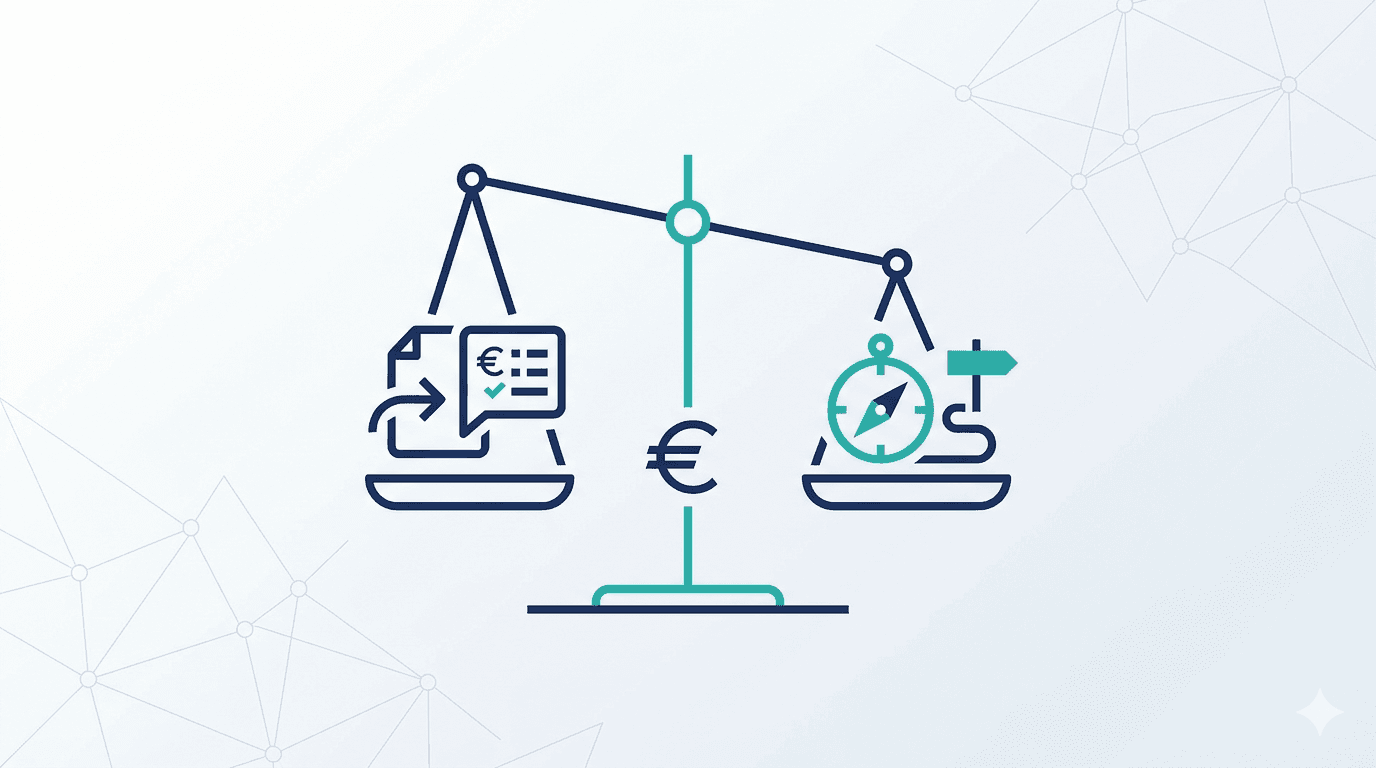
The BSIG does not require companies to appoint an ISB, but § 30 and § 38 call for a structure that steers measures. Tasks, position, in-house or external, and what an ISB costs in a worked example.
Written by the NIS2Compass editorial team / As of: November 2026
The BSIG requires only the federal administration to appoint an information security officer (ISB), not companies, yet § 30 and § 38 BSIG demand a managed implementation. In a worked example, an in-house ISB on a half-time position ties up around EUR 57,400 of working time per year, while an external ISB with two consultant days per month costs around EUR 31,200. For the appointment, NIS2Compass offers the template "CISO Mandate", the template for the ISB role.
Does a Company Have to Appoint an ISB Under NIS2?
No, the BSIG explicitly requires only federal administration bodies to appoint an information security officer. Under § 30 BSIG, companies must take and document appropriate measures, and under § 38 management must implement and oversee them; who coordinates this is left open by the law. For certain digital providers, however, an EU implementing regulation requires a directly responsible person, and for telecommunications providers the TKG requires a security officer.
The wording of § 45 (1) BSIG (translation):
"The head of each federal administration body shall appoint an information security officer for their body and designate at least one person authorised to act as deputy."
§§ 46 and 47 (departmental ISB, digitalisation projects) likewise concern only the federal government. The federal government expects around 8,250 particularly important and around 21,600 important entities in the private sector (Bundestag printed paper BT-Drs. 21/1501, pp. 110 f.). The wording makes it clear: none of them is explicitly required by the BSIG to appoint an ISB.
What Applies to Companies Instead?
- § 30 BSIG: Entities must take "appropriate, proportionate and effective technical and organisational measures" (translation), under (2) No. 1 for example "policies on risk analysis and on the security of information technology". Compliance "must be documented by the entities".
- § 38 BSIG: Management is obliged "to implement these measures and to oversee their implementation". According to the explanatory memorandum, BT-Drs. 21/1501, p. 154: "Even when assistants are engaged, the management body retains ultimate responsibility" (translation).
- Professional assessment: From NIS2Compass's perspective, policies, measures, evidence and reports to management are hardly manageable without a coordinating person. Whether this person is called "ISB" is secondary.
What Special Cases Exist?
- Digital providers: For digital providers such as cloud and data centre services, managed (security) service providers, DNS services, online marketplaces and trust service providers, Implementing Regulation (EU) 2024/2690 takes precedence (§ 30 (3) BSIG). Annex point 1.2.3: "At least one person shall be directly responsible to the management bodies for matters of network and information system security" (translation). Under point 1.2.4, this can be an additional role depending on size.
- Energy: Under the IT security catalogues, network and plant operators name an "IT security contact person" to the Federal Network Agency (BNetzA). This is a contact role, not an ISB title. According to the BNetzA, the catalogues remain in force until a new catalogue under § 5c EnWG is issued.
- Telecommunications: Anyone operating a public telecommunications network or providing publicly available telecommunications services must, under § 166 (1) No. 1 TKG, "designate a security officer" (translation). This is an obligation under the TKG, not the BSIG.
- Financial sector: Under § 28 (6) BSIG, DORA financial entities are exempt from §§ 30 and 38 and follow their own rules.
Whether your company is in scope at all is covered in the article NIS2 for SMEs: When Are You Affected and What Is Enough?.
What Does an ISB Do?
The ISB advises and supports management on information security. According to BSI Standard 200-2, the ISB steers the security process, supports the security policy, coordinates security concepts, initiates and reviews measures, reports to management, coordinates projects, investigates security incidents and organises training. Under NIS2, this provides the basis on which management fulfils its oversight duty.
BSI Standard 200-2 sets out as a basic rule: "At least one person (typically as information security officer) must be appointed" (translation). Overall responsibility remains with management. In practice, the ISB runs and coordinates the ISMS, meaning the interplay of rules, processes and responsibilities.
The BSI standard lists eight tasks. Mapping them to the obligations under § 30 BSIG is an editorial classification:
- Steering the security process: This is the backbone for the measures under § 30 (2) BSIG.
- Supporting the information security policy: Management drafts it, the ISB contributes. The "Information Security Policy" template is a good starting point.
- Coordinating the security concept, business continuity concept and sub-concepts: This corresponds to the policies under § 30 (2) No. 1 and business continuity under No. 3.
- Initiating and reviewing security measures: This feeds into the effectiveness assessment under § 30 (2) No. 6.
- Reporting to management: This enables management to oversee implementation under § 38 (1) BSIG. The "Management Review Minutes" and the "NIS2 Security KPI Dashboard" are helpful here.
- Coordinating security-relevant projects: The ISB is involved early, for example in new applications, IT or ICS systems.
- Investigating security incidents: This is the interface to incident handling under § 30 (2) No. 2 and to the reporting obligation.
- Coordinating awareness and training: This covers § 30 (2) No. 7. The ISB often helps organise the management training under § 38 (3).
The ISB does not implement everything personally. The ISB coordinates, reviews and reports. Implementation lies with IT, the business units and service providers.
What Qualifications and Position Does an ISB Need?
The BSIG contains no qualification requirement for an ISB in a company. The BSI expects knowledge of information security and IT, an understanding of business processes, project and risk methodology, and assertiveness. The role should be a staff position reporting directly to management, not part of the IT department, with a right of direct access, a qualified deputy and enough time: at least a half-time position is recommended.
What Should an ISB Bring to the Role?
In chapter 4.4, BSI Standard 200-2 describes a profile, not mandatory certificates:
- Overview: commitment to the security objectives and knowledge of the organisation
- Social skills: cooperation and teamwork, combined with assertiveness
- Methodology: project management experience, knowledge of risk analysis methods
- Expertise: basic knowledge of processes and business tasks, and of IT and ICS where required
The BSIG contains no continuing education requirement for an ISB in a company; the expertise requirement in § 45 (2) applies only to the federal government. According to the BSI, the ISB "should train and continue to train" so as to have the necessary expertise (translation).
Where Should the Role Sit in the Organisation?
- Staff position: assigned directly to management, free from instructions by other units
- Right of access: the "direct and unrestricted right of access" to management (translation), plus early involvement
- Not in the IT department: otherwise, according to the BSI, the role risks being reduced to IT protection and creating a conflict of roles
- Deputy: a qualified deputy; ISMS.1.A6 requires effective deputy arrangements
For IT-Grundschutz users, module ISMS.1 (Edition 2023) sets out basic requirement A4: "Management of the organisation MUST appoint an ISB" (translation), with adequate resources and a direct reporting line. This is a voluntary standard, not law. ISO/IEC 27001 requires assigned roles and responsibilities, but no "ISB" title (see NIS2 vs. ISO 27001).
For the time budget, the BSI implementation notes on ISMS.1 recommend at least a half-time position, and a full-time one in larger organisations. The "CISO Mandate" template from the NIS2Compass Template Library puts role, reporting line, powers and time in writing.
How Do the ISB, IT Management, Data Protection Officer and CISO Differ?
Management bears responsibility, the ISB steers the security process, IT management implements. The law generally requires a data protection officer once 20 or more people regularly process personal data by automated means, whereas the BSIG does not require an ISB. CISO is usually just another title for the ISB; what is critical is combining the role with active administration.
- Management: It must implement the risk management measures under § 38 (1) BSIG and oversee their implementation. In the event of violations, it is liable under § 38 (2) in accordance with company law, see management liability under § 38 BSIG.
- ISB: The ISB steers, coordinates, reviews and reports. The BSIG does not require companies to have an ISB.
- IT management: It runs the systems, implements technical measures and is the obvious candidate. According to BSI Standard 200-2, it is critical when an "active" administrator also takes on the ISB role, "as conflicts of interest are highly likely to arise" (translation). Combining the roles is not prohibited, but it should be justified and documented: anyone who reviews their own work gives management a report it can trust only to a limited extent.
- Data protection officer (DPO): Appointment is mandatory under Art. 37 GDPR and § 38 (1) BDSG if you "as a rule employ at least 20 persons who are constantly engaged in the automated processing of personal data" (translation). Data protection law requires a DPO above this threshold; the BSIG does not require an ISB. According to BSI 200-2, the two roles "are not fundamentally mutually exclusive".
- CISO: According to BSI 200-2, a common title for the same role, alongside ISB and ISM; IT-SiBe used to be customary. The term does not appear in the law.
- vCISO or external ISB: "Virtual CISO" is a market term for an external expert who takes on the ISB role part-time. Responsibility remains with management.
In-House or External: Which ISB Model Suits an SME?
Both are permitted: BSI Standard 200-2 considers an external ISB potentially useful in small companies and calls for qualified external experts if the role cannot be filled internally. According to the BSI, the contract must enable the external ISB to perform their tasks "at least as well as an internal ISB" (translation). Internal support is still required.
- In-house: knows the processes and people, is available, keeps knowledge in the company. Risks: day-to-day workload, combination with IT operations, no deputy.
- External: brings methodology and an independent view. Risks: onboarding, limited presence, dependency.
The BSI implementation notes on ISMS.1 treat the engagement as outsourcing (module OPS.2.1) and list these contract points:
- Framework: qualifications, tasks, deputy arrangements and minimum resources, costs
- Integration: reporting and escalation channels, communication channels, work locations and availability, physical, system and data access rights, the right to present to and the duty to report to management
- Safeguards: the client's duty to cooperate, confidentiality, conflicts of interest, consequences of contract breaches, termination with handover
Responsibility remains with management. Internally, you need a contact person who provides input and initiates measures. From NIS2Compass's perspective, one more point applies: if the same service provider also implements the technology, it is reviewing its own work. The trade-off is similar to the one for a gap analysis: in-house or with a consultant.
What Could This Look Like at an IT Service Provider With 80 Employees?
The following example is fictitious.
- Starting point: A managed service provider with 80 employees falls under Implementing Regulation (EU) 2024/2690. At least one person must be directly responsible to the management bodies for network and information security (Annex point 1.2.3).
- Problem: The obvious choice would be the technical director, who does administration personally. He would be checking himself, even though conflicting duties are to be segregated where applicable (point 1.2.5).
- Solution: An employee from quality management takes on the role as a staff position reporting to the managing directors, with a fixed share of her working time. In the first year, an external consultant supports her one day per month, and the commercial director acts as her deputy.
- Documentation: CISO Mandate, Management Board Resolution on NIS2 Compliance, Management Review Minutes. Roles are reviewed regularly and after significant incidents (point 1.2.6).
- Result: A named person reporting directly to management meets the implementing regulation's requirement. The conflict of interest is mitigated and documented.
What Does an Information Security Officer Cost In-House and External?
In the worked example, an in-house ISB on a half-time position ties up 920 hours per year, which at EUR 62.40 per hour comes to around EUR 57,400. In the same worked example, an external ISB with 12 to 36 consultant days at EUR 1,300 each costs EUR 15,600 to EUR 46,800 and covers only 10 to 31 percent of those hours. There is no neutral market price.
The scope and presence of external engagements vary widely. The following worked examples disclose their assumptions.
- In-house (worked example, not a market price): The BSI recommends at least a half-time position; the assumption is 20 hours per week and 46 working weeks: 920 hours. The hourly rate of EUR 62.40 is the wage rate for a high qualification level from the compliance cost estimate (BT-Drs. 21/1501, p. 113), applied there to training and transferred here. Result: 920 × EUR 62.40 = EUR 57,408, around EUR 57,400 per year. This is working time tied up, not a salary.
- External (worked example, not a market price): The assumption is 1 to 3 consultant days per month at the average rate of EUR 1,300 according to the BDU fee study 2025, surveyed for management consulting as a whole. At 2 days per month, 24 × EUR 1,300 gives EUR 31,200 per year; 12 to 36 days give EUR 15,600 to EUR 46,800. Depending on seniority, average BDU day rates range from EUR 700 (analyst) to EUR 1,600 (partner), so EUR 16,800 to EUR 38,400 for 24 days.
At 8 hours per day, 12 to 36 days equal 96 to 288 hours, around 10 to 31 percent of the half-time position. An external engagement does not replace internal work; internal support comes on top. More in What external NIS2 consulting costs.
For comparison, the federal government estimates the following annual effort for all measures under §§ 30, 31 and 38 (1) BSIG (BT-Drs. 21/1501, pp. 110 f.):
- Particularly important entities: 2,752 hours plus EUR 60,700 in material costs
- Important entities: around 1,100 hours plus EUR 24,300 in material costs
This covers the entire security level, not just the ISB. The half-time ISB position alone would already equal around 84 percent of the 1,100 hours. Either the federal government's assumption is tight, or SMEs scope the role more leanly.
Calculate both options with your own assumptions and present the result to the managing directors for a decision. The "Management Board Resolution on NIS2 Compliance" and "CISO Mandate" templates from the NIS2Compass Template Library put the resolution and the role in writing. Set the first reporting date to the managing directors directly in the mandate.
Frequently Asked Questions
Can the IT manager also be the ISB?
It is not prohibited; the BSIG does not address this question. However, BSI Standard 200-2 advises against placing the ISB in the IT department and expects conflicts of interest when an "active" administrator holds both roles. If there is no other way, document the conflict and secure a right of direct access to the managing directors. Critical points should then be reviewed independently.
Can the data protection officer also act as ISB?
Yes, according to the BSI the roles are not fundamentally mutually exclusive. The interfaces should be documented first, both roles need direct reporting lines to management, and the person needs enough time for both tasks. The difference: § 38 BDSG generally requires a DPO once 20 or more people regularly process personal data by automated means. The BSIG does not require companies to have an ISB.
Does a company with 60 employees need an ISB?
Not under the BSIG, provided it is neither a digital provider within the meaning of Implementing Regulation (EU) 2024/2690 nor a telecommunications provider under § 166 TKG. If it falls under the BSIG, however, it must implement and document measures under § 30, and management oversees them under § 38. The BSI recommends at least a half-time position. In smaller organisations, a member of management often takes on the task personally.
Is the ISB liable if something goes wrong?
The BSIG does not regulate a separate ISB liability. Special protection against dismissal or discrimination exists only for ISBs in the federal administration, for example under § 45 (4) BSIG. Under § 38 (1), implementing and overseeing the measures is the responsibility of management, which is liable under (2) in accordance with company law. Employment law questions need to be clarified case by case.
How is an ISB appointed?
There are no formal requirements for companies. A written appointment by the managing directors setting out tasks, powers, reporting line, deputy and time budget has proven effective. For an external ISB, a contract following the points in the BSI implementation notes on ISMS.1 is advisable. For this purpose, NIS2Compass offers the "CISO Mandate" template in its Template Library.
Implement NIS2 step by step
NIS2Compass guides you step by step through implementation – with an Implementation Guide, templates and Knowledge Hub.
Get startedRelated Articles
NIS2 Risk Assessment Under § 30 BSIG: Method, Steps, Example
What § 30 BSIG requires of the risk assessment, how deep it must go in an SME, which method fits and what a worked example looks like in five steps.
9 min read
NIS2 Measures: The 10 Minimum Measures Under § 30 BSIG
§30(2) BSIG names ten minimum measures. What the law requires for each, how SMEs can implement them proportionately, and which template provides the evidence.
13 min read
NIS2 Documentation: Which Documents Are Mandatory?
§30 BSIG requires you to document compliance but names no fixed list of documents. What the law requires, what is practice, and who can ask for evidence and when.
9 min read